Key Takeaways
- Temperature control is the #1 factor separating consistent espresso from unpredictable shots, with water temperature fluctuations as small as 2°C drastically altering flavor profiles.
- Single boiler machines require "temperature surfing" and can't brew and steam simultaneously, making them ideal for single-drink workflows but limiting during busy periods.
- Heat exchanger systems enable simultaneous brewing and steaming but need cooling flushes to prevent overheated water from scorching your coffee.
- Dual boiler machines offer the highest stability (±1°C temperature variance) with independent control systems, but their complex maintenance requirements aren't suitable for every home setup.
Choosing the right boiler type determines whether your espresso machine becomes a reliable brewing partner or a source of daily frustration. Beyond the marketing specs, each architecture creates fundamentally different thermal behaviors that directly impact extraction quality and workflow efficiency.
Temperature Control Separates Great Espresso From Bad
Water temperature during extraction is the invisible force determining whether your espresso tastes balanced or becomes an undrinkable mess. Even a 2°C temperature swing can shift your shot from perfectly extracted to sour and acidic or bitter and harsh. This happens because different flavor compounds extract at different rates—lower temperatures under-extract acids and sugars, while higher temperatures over-extract bitter compounds and tannins.
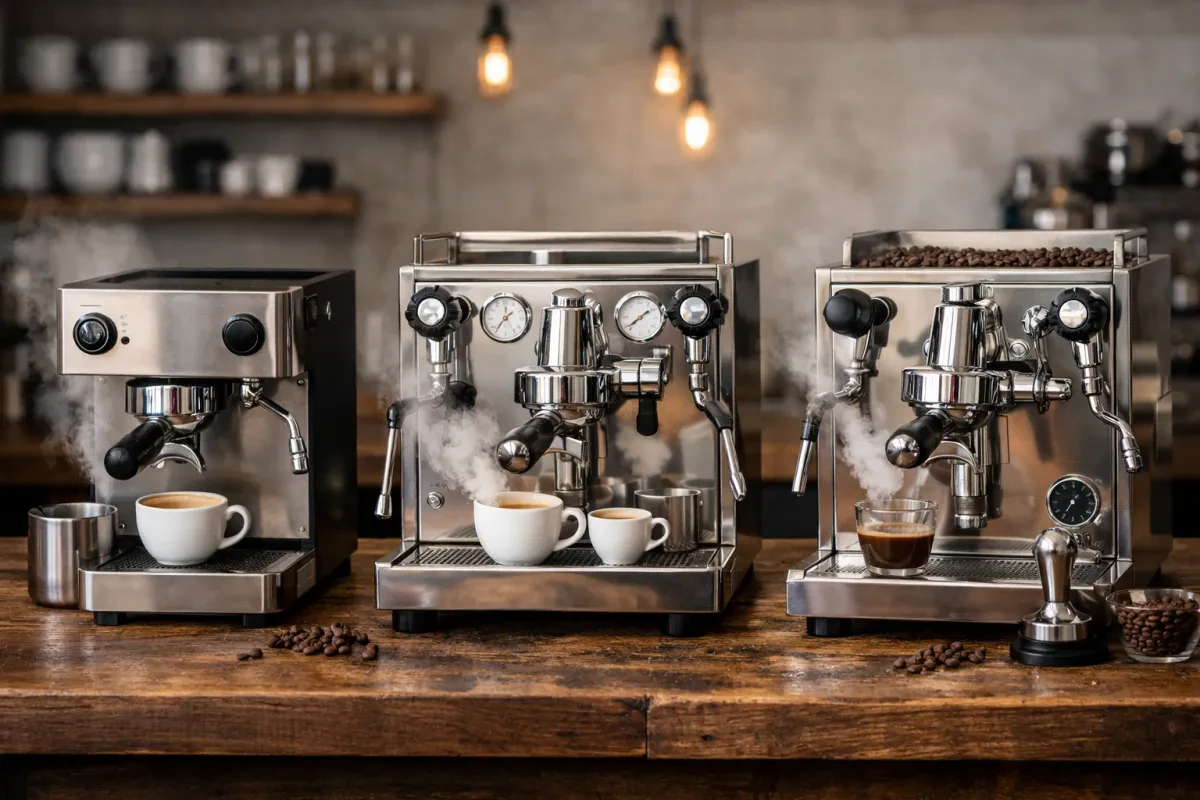
The three main boiler architectures—single boiler, heat exchanger, and dual boiler—each handle this critical temperature stability challenge differently. Below, Brew Precision analyzes how these thermal management systems impact real-world brewing performance — and if you're weighing up specific models, our complete guide to espresso machines under $1,000 maps these boiler architectures to the machines actually available at home-barista budgets.
Professional baristas understand that thermal consistency isn't just about hitting the right temperature once; it's about maintaining that temperature throughout the entire 25-30 second extraction process. When water temperature drops mid-shot, the extraction becomes uneven, creating muddy, confusing flavors that no amount of grind adjustment can fix.
Which boiler type is right for your setup? The answer depends on how you actually make coffee — not how you imagine you might. Answer four quick questions below to get a personalized recommendation based on your daily workflow, experience level, and tolerance for manual calibration.
No boiler type is universally superior — each involves real trade-offs in workflow, maintenance, and thermal behavior. Use your result as a starting point, then explore the full breakdown of each architecture in the sections below to confirm your choice against the technical details that will actually define your daily experience.
Single Boiler Systems: Manual Temperature Surfing Required
How Single Boilers Create Temperature Swings
Single boiler machines use one pressure vessel for both brewing and steaming, creating an inherent thermal management problem. Traditional bimetallic thermostats operate on a deadband system — they only activate the heating element after the water temperature drops significantly below the target, then cut power after exceeding an upper limit. This creates continuous temperature oscillations, sometimes ranging from 85°C at the low point to 110°C at the peak during idle cycles.
The heating element's thermal inertia compounds this problem. Even after the thermostat cuts electrical power, the element continues transferring heat into the water, causing substantial temperature overshoot. Meanwhile, the small boiler capacity (typically 100-300ml) means that incoming cold water during extraction dramatically impacts the overall thermal mass, causing significant intra-shot temperature drops.
Temperature Surfing: Manual Control for Consistency
Skilled operators compensate for these thermal swings through "temperature surfing"—a manual protocol that forces predictable thermal baselines. The process involves running the pump with an empty group head until the temperature drops enough to trigger the heating element. Once the element turns off (indicated by a panel light), the operator waits a specific, timed interval to let the boiler cool to the target temperature.
A light roast requiring high extraction temperature might need only a 5-second wait after the heating element cycles off, while a dark roast requiring cooler water might demand a 15-second delay. Some operators use the "steam switch trick," briefly engaging the high-temperature steam thermostat to boost brew temperature when the machine runs too cool. Modern single boiler machines with PID controllers eliminate idle hysteresis but still suffer thermal degradation during back-to-back shot production due to small thermal mass limitations.
Why Simultaneous Brewing and Steaming Isn't Possible
Single boiler machines are physically incapable of brewing and steaming simultaneously because both operations require mutually exclusive thermal states within the same pressure vessel. Transitioning from brewing (93°C) to steaming (125°C+) requires engaging the steam switch and waiting up to two minutes for the heating element to generate sufficient steam pressure.
This workflow bottleneck forces operators to choose their sequence carefully. Extracting espresso first means the shot experiences some flavor changes while the machine heats for steaming, though significant deterioration typically takes longer than the few minutes required. Steaming first leaves the boiler filled with superheated water that would destroy the coffee puck if used immediately for brewing. Operators must perform a manual cooling flush — running the pump while opening the steam valve to purge superheated water until the flow changes from violent sputtering to a steady stream, indicating proper brewing temperature.
$499.00
$449.00
4.83 out of 5 stars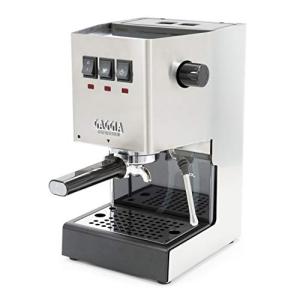
Gaggia E24 Brushed Stainless Espresso Machine
Brew barista-quality espresso at home with ease and style
Product information
Product Review Score
Product links
$995.00
4.12 out of 5 stars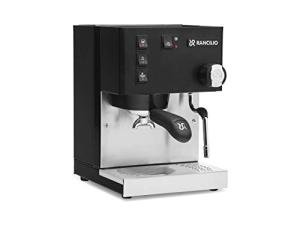
Rancilio Silvia Espresso Machine - Black Finish
Experience barista-quality espresso at home with the sleek and stylish Rancilio Silvia Espresso Machine
Product information
Product Review Score
Product links
Heat Exchanger Machines: Workflow Freedom With Cooling Flushes
Thermosyphon Loop Keeps Group Head Hot
Heat exchanger machines solve the simultaneous operation problem through elegant thermodynamic design. Cold brew water travels through a sealed copper tube submerged in a large steam boiler maintained at 125°C. The brew water never mixes with the boiler water — it only absorbs heat through the thermally conductive tube walls as it passes through.
Most high-end heat exchangers use the legendary E61 group head: a 9-pound brass block maintained at brewing temperature through a passive thermosyphon loop. Two parallel pipes connect the internal heat exchanger to the external group head: an upper delivery pipe and lower return pipe. Hot, less-dense water rises through the upper pipe into the group head, transfers its heat to the brass, becomes cooler and denser, then sinks down the return pipe. This gravity-driven circulation requires no pump and keeps the massive brass group head fully saturated with heat.
Idle Overheating Requires Cooling Flushes
The heat exchanger's greatest strength becomes its weakness during idle periods. Water trapped in the thermosyphon loop continuously absorbs heat from the 125°C steam boiler, eventually overheating beyond proper brewing temperature. If operators pull a shot without intervention after the machine sits idle, this superheated water flash-boils at atmospheric pressure, violently scorching the coffee extraction.
Operators must perform a "cooling flush" before each shot after idle periods. They activate the pump, letting overheated water spray from the group head. Initially, the water sputters and hisses as it flash-boils, emitting steam wisps. As superheated water is purged and replaced by cooler reservoir water, the flow calms to a uniform stream. Operators then count additional flush seconds to dial in their exact target temperature before immediately locking in the portafilter and starting extraction.
Flow Restrictors: Trading Flushes for Recovery Speed
Modern manufacturers install flow restrictors (gicleurs) — tiny metal orifices — in the upper thermosyphon delivery pipe to reduce manual cooling flushes. By restricting fluid pathway diameter, natural convection slows artificially, limiting superheated water volume reaching the group head. This allows ambient brass cooling to outpace the heating loop, creating a group head that rests at correct brew temperature without flushing.
However, flow restrictors introduce a thermal recovery compromise. The restricted thermosyphon cannot cycle thermal energy quickly enough to recover heat lost during extraction. Heavily restricted heat exchanger machines work well for casual home use but fail in high-volume environments requiring rapid thermal recovery for consecutive shots.
$2,149.00
4.3 out of 5 stars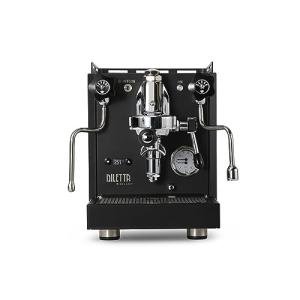
Diletta Bello+ Espresso Machine with PID Control
Experience barista-quality espresso from the comfort of your kitchen with this user-friendly machine that offers precise temperature control
Product information
Product Review Score
Product links
Dual Boiler Architecture: Separate Systems for Maximum Stability
Independent Temperature Control With PID Controllers
Dual boiler machines represent the apex of espresso engineering by eliminating all thermodynamic compromises through brute-force isolation. Two completely separate pressure vessels with independent heating elements and dedicated temperature controllers handle brewing and steaming independently. The hydraulic circuit physically splits after the pump: one path leads to the steam boiler (125-135°C), the other to the dedicated brew boiler (93-96°C).
Dual PID controllers provide algorithmic temperature management impossible with mechanical thermostats. These sophisticated logic boards constantly monitor water temperature via sensitive thermistors, calculating proportional, integral, and derivative corrections to prevent error. They deliver micro-pulses of electricity via solid-state relays to heating elements, providing exactly enough thermal energy to maintain set points without overshoot or oscillation.
Pre-Heating Coils Maintain Back-to-Back Performance
Advanced dual boiler machines employ cold-water pre-heating to maintain thermal stability during high-volume use. If ambient 20°C water entered a small 93°C brew boiler directly during extraction, the thermal shock would drastically lower overall boiler temperature. Engineers route cold inlet water through copper heat exchange coils inside the 130°C steam boiler before entering the brew boiler, passively heating it to roughly 85°C.
This pre-heating ensures the brew boiler's heating element only overcomes an 8°C temperature delta rather than 73°C, maintaining absolute stability even during prolonged extraction cycles. Some manufacturers use "saturated" group heads — physically welding the group head directly to the brew boiler face and flooding the hollow cavity with identical boiler water, eliminating temperature gradients and heat loss from external piping.
True Simultaneous Operation Without Compromises
Dual boiler operational parallelism is absolute. Because hydraulic circuits, thermal properties, and heating elements are entirely divorced, operators can extract espresso while simultaneously drawing maximum steam pressure for milk texturing. Extraction pressure won't fluctuate, brew temperature won't crash, and steam velocity won't diminish. This isolation enables energy efficiency in domestic settings — operators can turn off the steam boiler when not making milk drinks, reducing idle power consumption significantly.
The algorithmic management allows dual boilers to hold extraction temperatures within ±1°C across multiple consecutive shots. There's no thermal wave, no hysteresis, and no need for complex temperature surfing or cooling flushes. Operators can program exactly 94°C, let the machine idle for hours, and pull shots with absolute certainty that water will strike the puck at precisely 94°C.
$459.00
4.49 out of 5 stars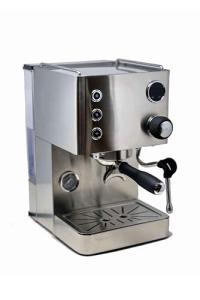
Turin Legato Dual Boiler Espresso Machine
Brew barista-quality espresso right at home with this easy-to-use, powerful dual boiler machine
Product information
Product Review Score
Product links
Maintenance Reality: What Actually Breaks and Why
1. Scale Buildup Destroys Heating Elements
Scale formation represents the most universal threat across all boiler types, but impacts each architecture differently. Hard water subjected to boiling temperatures rapidly precipitates dissolved calcium carbonate, forming calcified crusts on internal surfaces. Scale acts as thermal insulation — when heating elements become coated, they must work harder and stay energized longer to transfer heat into surrounding water.
Single boiler machines are highly susceptible to scale damage due to the dual-purpose nature and rapid temperature cycling, as the same water pathway handles both sub-boiling extraction and high-heat steam generation. Heat exchanger steam boilers concentrate scale because water only exits as vapor through the steam wand, leaving mineral content behind. This extreme concentration makes descaling the steam boiler notoriously difficult — many heat exchanger machines lack dedicated boiler drain valves, requiring technicians to physically invert heavy machines or flush gallons through the hot water wand.
2. Three-Way Solenoids Clog From Coffee Particles
The three-way solenoid valve is a frequent and common mechanical failure point in pump-driven machines, though other issues like scale buildup, leaks, and heating element failures are also very common. This electro-mechanical valve simultaneously cuts water flow from the boiler and opens an exhaust bypass to vent residual pressure into the drip tray when extraction ends. The solenoid handles backflow from coffee pucks, exposing it to fine particulate, oils, and mineral scale flakes.
When microscopic internal orifices become occluded, machines exhibit complete flow loss despite pump operation. Single boiler machines often provide relatively straightforward solenoid access for cleaning. Heat exchanger and dual boiler machines often require more complex disassembly due to parallel plumbing circuits, but the basic cleaning process involves soaking valve components in specialized detergent or mild descaling acid.
3. Thermosyphon Stalls From Air Bubbles
Heat exchanger machines face a unique failure mode: thermosyphon stalls. Natural convection requires completely filled, incompressible water circuits. Air bubbles entering the system — from depleted reservoirs, failing check valves, or micro-boiling within the heat exchanger — become trapped at the loop's highest point, breaking hydraulic continuity.
Without continuous thermal energy circulation, the massive brass group head rapidly dissipates heat and becomes cold. When shots are finally pulled, cold brass acts as a thermal sink, extracting heat from incoming brew water and producing severely under-extracted, sour espresso. Resolving stalls requires running the pump to forcefully bleed air from the group head until proper circulation resumes. Scale buildup in narrow thermosyphon passages, particularly flow restrictor gicleurs less than 1mm in diameter, can also mimic stall symptoms through partial blockages.
The table below consolidates the key architectural differences across all three systems before the workflow-matching guidance that follows.
| Criteria | Single Boiler | Heat Exchanger | Dual Boiler |
|---|---|---|---|
| Temperature Stability | Oscillates; requires temperature surfing to manage | Good with cooling flush; varies by flow restrictor setup | ±1°C via dual PID controllers |
| Simultaneous Brew + Steam | ✗ Not possible | ✓ Yes | ✓ Yes (fully independent) |
| Manual Ritual Required | Temperature surfing (timing-based) | Cooling flush before shots after idle | None |
| Boiler Capacity | Small (~100–300ml); sensitive to thermal shock | Large steam boiler; brew water heated via HX tube | Two dedicated vessels; pre-heating coil on advanced models |
| Primary Failure Modes | Scale buildup; solenoid clogs | Thermosyphon stalls; steam boiler scale concentration; solenoid clogs | Scale across two systems; solenoid clogs; complex disassembly for maintenance |
| Maintenance Complexity | Low — simpler architecture, easier access | Medium — parallel plumbing; steam boiler descaling difficult without drain valve | High — two boilers, complex plumbing, requires more knowledge |
| Best Suited For | Single-drink workflows; espresso enthusiasts who enjoy manual involvement | Multiple milk drinks daily; households that entertain | High-volume use; data-driven extraction; users unwilling to compromise on consistency |
Choose Based on Your Workflow, Not Just Budget
The right boiler type depends more on daily usage patterns than initial investment. Single boiler machines work well for dedicated espresso drinkers, and the simple architecture means easier maintenance and repair.
Heat exchanger machines suit households making multiple milk drinks daily or entertaining frequently. The simultaneous operation capability and powerful steam performance offset the cooling flush requirement.
Dual boiler machines serve users demanding absolute consistency and professional-grade performance. They're needed for high-volume environments, data-driven espresso experimentation, or anyone unwilling to compromise on thermal stability. However, their complexity requires more maintenance knowledge and higher ongoing costs.
The thermal management system you choose becomes part of your daily coffee routine — make sure it matches how you actually want to make coffee, not just how you imagine you might. Visit Brew Precision for detailed buying guides that help match espresso machine architectures to real-world usage patterns.